

Below you’ll find Lowenfeld’s stages, Rhoda Kellogg’s scribble sequence, CDC and NHS shape and person milestones, G.-H. Luquet’s ideas about realism and a stages-by-age chart. Our planned hub on children’s drawings covers more.
What Are the Stages of Drawing Development?
The stages of drawing development are the typical steps children pass through as their drawings change with age. A widely used model comes from Viktor Lowenfeld and W. L. Brittain: scribble, preschematic, schematic, dawning realism, pseudo-naturalistic and decision-making. Ages for each stage differ between sources by up to 2 years, so treat every age as “about”.
Lowenfeld’s Stages
Viktor Lowenfeld (1903 to 1960) was an Austrian-born art educator and psychologist and a professor at Pennsylvania State University. In 1947 he wrote Creative and Mental Growth, the book that sets out the stages of artistic development. The Library of Congress record for its 8th edition (Macmillan, 1987) lists Lowenfeld and W. Lambert Brittain as authors.
A handout from The Art of Education University, citing Lowenfeld and Brittain (1987), gives these 6 stages:
- Scribble (2 to 4 years): children explore mark making and later name their scribbles.
- Preschematic (4 to 7 years): children draw circles that stand for people or animals.
- Schematic (7 to 9 years): a baseline and skyline appear, and figures and details relate to each other in space.
- Pre-realism (9 to 11 years): children add perspective, overlapping and detail, and grow more self-conscious. Other summaries call this stage dawning realism or the gang age.
- Pseudo-naturalistic (11 to 13 years): visually oriented artists study shading and perspective, while others use color to show feeling.
- Decision-making (14+ years): older artists begin to master skills and media and make purposeful choices in their art.
Why the Ages Differ
None of the summaries cited here reproduces the age table from Lowenfeld and Brittain’s book itself. Three more sources show the spread:
- A LibreTexts college text (Irvine Valley College): scribble about 1 to 4, preschematic 4 to 7, schematic 7 to 9 and dawning realism 9 to 12.
- University of Saskatchewan course notes: scribbling at about 2, preschematic 3 to 5, schematic 6 to 8, the gang stage 8 to 12, pseudo-naturalistic 12 to 14 and decision 14 to 16.
- A 2025 study by P. Gil-Ruiz and colleagues in Education Sciences: scribbling 2 to 4, preschematic 4 to 7 and schematic 7 to 9.
Real children vary too. The Gil-Ruiz team rated 218 drawings collected in Madrid schools. They found preschematic drawings in some 3-year-olds and scribbling that lasted into some 5-year-olds. Their conclusion: Lowenfeld’s model is still a valid framework, but it should be applied flexibly.
What Happens in the Scribbling Stage?
In the scribbling stage, a child makes marks for the feel of moving the crayon, then slowly gains control of the lines. The CDC lists “scribbles” as a milestone most children reach by 18 months. ZERO TO THREE describes random scribbling from about 15 months to 2½ years and controlled scribbling from about 2 to 3.

Random scribbles usually come from large shoulder movements, with the crayon held in the fist, according to ZERO TO THREE. Controlled scribbles repeat marks such as open circles and straight or curved lines. At first, children name a picture after they finish it. Later, they plan the drawing before they start.
Kellogg’s 20 Basic Scribbles
Rhoda Kellogg was a psychologist and nursery school educator. From 1948 to 1966 she collected about one million drawings by children aged 2 to 8, according to the Rhoda Kellogg Child Art Collection archive. More than half a million of them are held by the Golden Gate Kindergarten Association in San Francisco.
Kellogg sorted scribbles into 20 basic scribbles that can be seen at about age 2. Her list starts with the dot and the single vertical line and ends with the imperfect circle. The Tasmanian early-years booklet “Making Marks” explains that the 20 types show how children move from random to controlled scribbles.
From Scribbles to Shapes
Kellogg described an order that leads from scribbles to the first humans. The Kellogg archive and the “Making Marks” booklet list 6 steps after the basic scribbles:
- Placement patterns: from about age 2, children care where marks go on the page.
- Emergent diagram shapes: around age 3, scribbles start to look like rough shapes, and children may name them.
- Diagrams: single outline shapes, which Kellogg listed as the circle, cross, X, square, triangle and odd form.
- Combines: two basic shapes joined, around ages 3 to 4.
- Aggregates: three or more basic shapes joined.
- Mandalas, suns and radials: the last designs before people appear. Kellogg suggested that the sun and mandala lead to the first drawings of humans.
When Can Kids Draw a Circle, Square and Triangle?
Children typically draw a circle by about 3, copy a cross and square at about 4 to 5, and copy a triangle at about 5 to 6. The CDC lists drawing a circle “when you show him how” by 3 years. Two NHS children’s therapy sheets give a copying age for each shape.

The shape milestones below come from the CDC, the Evelina London occupational therapy pack (Guy’s and St Thomas’ NHS Foundation Trust) and the University Hospitals Birmingham (UHB) NHS “Early handwriting skills” sheet:
- Vertical line: copied at about 1½ to 2 years (Evelina).
- Horizontal line: copied at about 2½ to 3 years (Evelina).
- Circle: copied at about 2½ to 3 (Evelina), drawn when shown by 3 (CDC), and drawn alone at 3 to 4 (UHB).
- Cross: copied at about 4 to 4½ (Evelina) or 4 to 5 (UHB).
- Square: copied at about 4½ to 5 (Evelina) or 4 to 5 (UHB).
- X shape: copied at about 4½ to 5 (Evelina).
- Triangle: copied at about 5 years 3 months (Evelina), or started at 5 to 6 (UHB).
The UHB sheet calls its ages a guide only. It adds that pre-writing skills depend heavily on experience and chances to practice.
At What Age Can a Child Draw a Person?
The first recognizable person, the “tadpole” figure, emerges around age 3, and most children draw a person with 3 or more body parts by 4. The CDC lists the 3-part person as a milestone by 4 years. A UHB NHS sheet lists a person with at least 6 body parts at 5 to 6 years. Easy figures to practice are in simple figure and face drawings.

A tadpole figure is a round head with two vertical lines attached for legs. A. Gernhardt, H. Rübeling and H. Keller call it the child’s first recognizable drawing of a person, in a 2015 paper in Frontiers in Psychology. Tadpoles have been observed in Western and non-Western countries. The study analyzed tadpole self-drawings from 183 children aged 3 to 6 in 7 cultural groups. It found a shared drawing principle in all 7 groups, while single drawing features differed by cultural setting.
Tadpoles last into age 4 for many children. U. Podobnik and colleagues (Heliyon, 2021) report two earlier findings:
- Taylor and Bacharach (1981): 42% of 3-year-olds and 45% of 4-year-olds drew a tadpole figure.
- Cox (1993): the average age of children drawing a tadpole was 4 years and 1 month.
The same paper says eyes are usually the first facial feature to appear. Not every child draws tadpoles. In the Heliyon case study of triplets, two children went almost straight to a conventional human figure at age 3. That study covered only 3 children, so it shows the tadpole is not a required step, not how often children skip it.
When your child is ready for more figure shapes, our planned guide on how to teach kids to draw people breaks a figure into simple steps.
What Do Kids Draw at Ages 2, 3, 4 and 5?
At 2, kids scribble; at 3, they draw circles and first tadpole people; at 4, they draw a person with 3 or more parts; at 5, they copy squares and start triangles. These are typical ranges from the CDC, NHS sheets and drawing research. Many healthy children reach each one earlier or later.
Age 2
A 2-year-old mostly scribbles, with growing control and marks placed with care on the page.
Age 3
A 3-year-old draws a circle when shown how, names rough shapes and may draw a first tadpole person. ZERO TO THREE places pictures of objects or people at 3 to 5 years. Our planned page on what age kids start drawing covers first drawings.
Age 4
A 4-year-old holds the crayon between fingers and thumb, not in a fist (CDC). Objects float around the page, and early trees look like armless people, as the “Making Marks” booklet describes.
Age 5
A 5-year-old copies squares and Xs and starts triangles. Some 5-year-olds still scribble, as the 2025 Madrid study found.
How Do Drawings Change From Age 6 to 12?
From about 6 to 9, children draw planned pictures with a ground line and repeated symbols; from about 8 to 12, they chase realism and become more self-critical. These are Lowenfeld’s schematic and dawning realism stages. Sources date the schematic stage at 6 to 8 or 7 to 9.
Schematic Stage
In the schematic stage, a baseline (the ground) and a skyline appear. Children repeat a consistent schema, a stable symbol for houses, trees and people, according to the LibreTexts text. A 7-year-old may draw the same house on the same ground line in picture after picture.
Dawning Realism and the Gang Age
In dawning realism, children notice proportion, detail and how the parts of a drawing relate, according to the LibreTexts text. The Saskatchewan notes describe space shown with overlapping objects and a horizon line instead of a baseline. Children compare their work with others and judge it more harshly. For older kids, see our planned page of art activities for elementary kids.
Ages 11 and Up
In the pseudo-naturalistic stage (11 to 13 or 12 to 14 by source), children aim for “adult-like” drawings with light, shadow and distance, per the Saskatchewan notes. In the decision stage (from about 14), a teen chooses whether to keep developing drawing skills.
Why Don’t Young Kids Draw Realistically?
Young kids often draw an object as they know it, not as they see it. G.-H. Luquet called this intellectual realism. His 1913 study of his daughter’s drawings is described as the foundation of later theories of children’s drawing, in the 2021 Heliyon paper by U. Podobnik and colleagues.

Luquet described 4 phases on the way to visual realism. A 2025 summary by Gil-Ruiz and colleagues dates them as follows:
- Fortuitous realism: about 2 to 4 years.
- Frustrated (failed) realism: about 4 to 5 years.
- Intellectual realism: about 6 to 9 years.
- Visual realism: about 9 to 12 years.
These ages come from a modern summary, not from Luquet’s own text, and the phase names are translated in different ways. In intellectual realism, a child draws an object as it “is”, in its typical view, even when drawing from a model. In visual realism, a child draws it as it “is seen” from one viewpoint.
What Does a Drawing Stages by Age Chart Show?
A drawing stages by age chart lines up each stage with its typical age and what you see on the paper. The chart below combines Lowenfeld’s stages, Kellogg’s scribble sequence, and CDC and NHS shape and person milestones. Each age range spans the sources named in this guide, so read every age as “about”.
| Stage | Typical age (about) | What you see | Shapes and people |
|---|---|---|---|
| Random scribbling | 15 months to 2½ years | Marks from big shoulder movements, crayon in a fist | Most scribble by 18 months (CDC); vertical line copied 1½ to 2 (NHS) |
| Controlled scribbling | 2 to 3 years | Kellogg’s 20 basic scribbles, marks placed with care | Horizontal line and circle copied 2½ to 3 (NHS) |
| Shapes and first symbols | 3 to 4 years | Rough shapes, named scribbles, combined shapes, suns | Circle when shown by 3 (CDC); tadpole person from about 3 |
| Preschematic | 3 to 7 years | Circle-and-line people, objects floating on the page | Person with 3+ body parts by 4 (CDC); cross 4 to 4½, square and X 4½ to 5, triangle 5 years 3 months (NHS); person with 6+ parts at 5 to 6 (NHS) |
| Schematic | 6 to 9 years | Baseline and skyline, repeated symbols for houses, trees and people | Figures and details related in space |
| Dawning realism (gang age) | 8 to 12 years | More detail and proportion, overlapping objects, self-criticism | Perspective and more detail in figures |
| Pseudo-naturalistic and decision | 11 years and up | Shading, perspective, purposeful personal style | Purposeful choices of media and emphasis |
The overlapping ages are deliberate. The “Making Marks” booklet says the ages from Kellogg and Lowenfeld are only a guide, because each child grows as an artist in a unique way.
How Can You Support Each Stage of Drawing?
You support each stage of drawing by matching the materials and your words to what your child already does. Give a scribbler big paper and chunky crayons, give a 4-year-old shapes to combine, and give an older child chances to plan and observe. Short, regular drawing time gives your child the practice the UHB sheet links to pre-writing skills.
Scribbling Stage (About 1 to 4)
- Tape a large sheet of paper to the table so it does not slide.
- Offer chunky crayons that fit a fist grip.
- Ask your child to tell you about the drawing, instead of guessing what it is.
Our planned page on drawing for toddlers collects ideas for this stage.
Preschematic Stage (About 3 to 7)
- Draw circles, lines and crosses side by side with your child.
- Leave room for your child’s own figures, tadpoles included.
- Name body parts together, such as eyes, arms and feet, while your child draws.
The “Making Marks” booklet warns that around ages 4 to 7 adults often hand children formulas to copy, such as stick figures, so balance any formula with free drawing time. More ideas will sit on our drawing for preschoolers and drawing for kindergarten pages.
Schematic Stage (About 6 to 9)
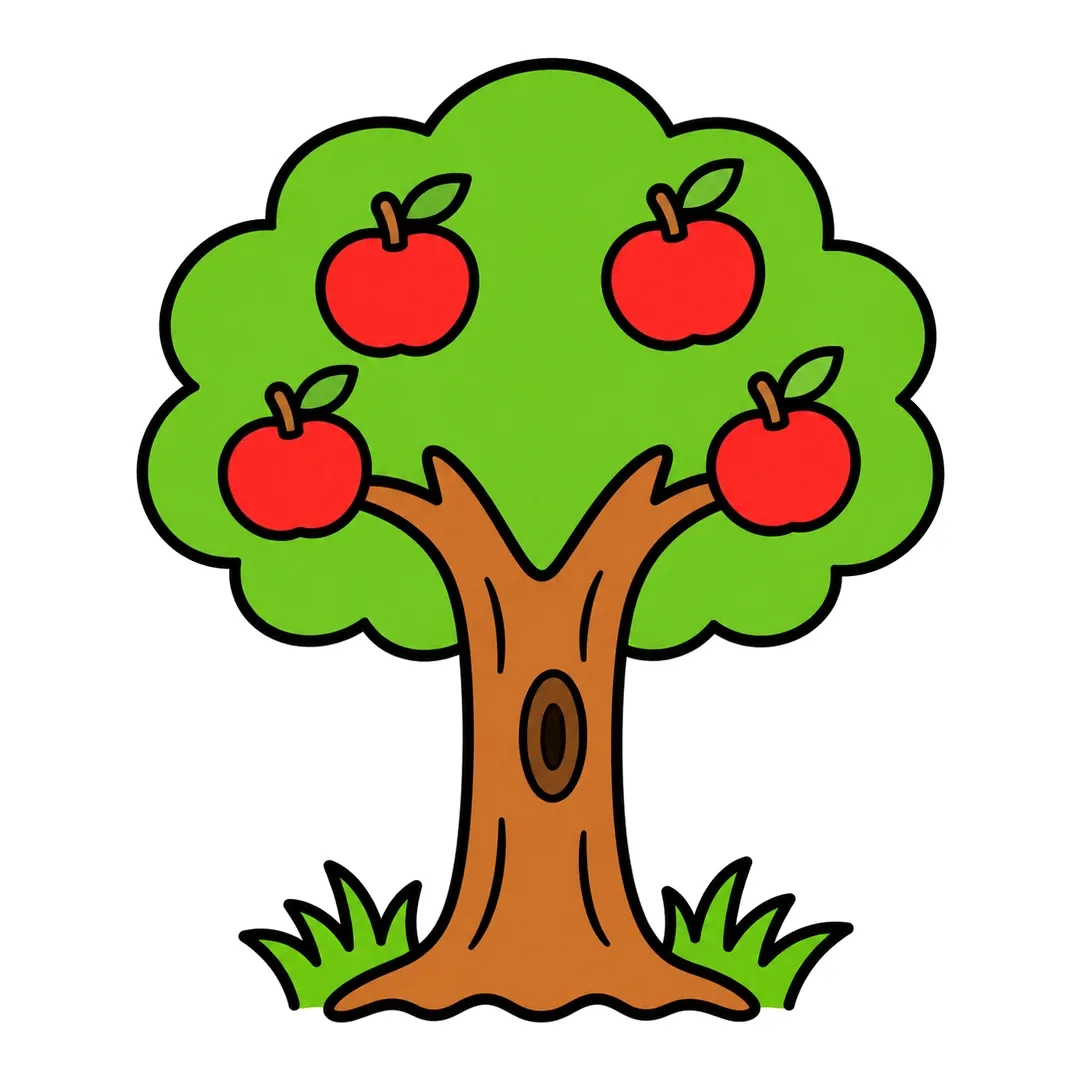
- Draw a ground line together and place the house, tree and people on it.
- Try a step-by-step drawing, which builds a picture from circles, lines and simple shapes.
- Display finished drawings so your child can see the same symbol improve over time.
Our how to draw a house and how to draw a tree tutorials use the same objects children repeat at this stage. The directed drawing page explains how adults lead step-by-step drawing with a group.
Dawning Realism and Later (About 8 and Up)
- Set up simple still lifes, such as a cup or a shoe, to draw from life.
- Point out overlapping, shading and proportion in books your child likes.
- Praise effort and choices, not only accuracy, because self-criticism grows in this stage.
When Should You Talk to Your Child’s Doctor About Drawing?
Talk to your child’s doctor when your child is not meeting one or more milestones, has lost skills, or you have other concerns. That is the CDC’s “act early” advice, and drawing milestones are part of the CDC checklists. CDC milestones are things most children (75% or more) can do by a certain age, so some children reach them later.
The CDC Milestones by 4 Years page asks parents to share concerns with the child’s doctor and ask about developmental screening. It also says its “Learn the Signs. Act Early.” materials do not replace standardized, validated developmental screening tools.
This guide does not diagnose anything from a drawing, and a stage chart is not a screening tool. ZERO TO THREE notes that its timetables are approximate and that a child may master these skills faster or slower and still be developing just fine.
Where Can Your Child Practice Easy Drawings?
You can practice easy drawings with your child using our free step-by-step tutorials, step sheets and drawing book. Each tutorial breaks a drawing into 4, 6 or 8 steps built from circles, lines and simple shapes, so a child who copies circles and lines can follow along. The lines and shapes themselves are taught in drawing basics for kids.

Each tutorial has a free step sheet PDF, sent by email from the form on the tutorial page; see the step sheets page. For a bigger set at once, request 20 Easy Drawings for Kids, our free 44-page book sent by email. Our planned page on the benefits of drawing for kids explains why drawing time matters.